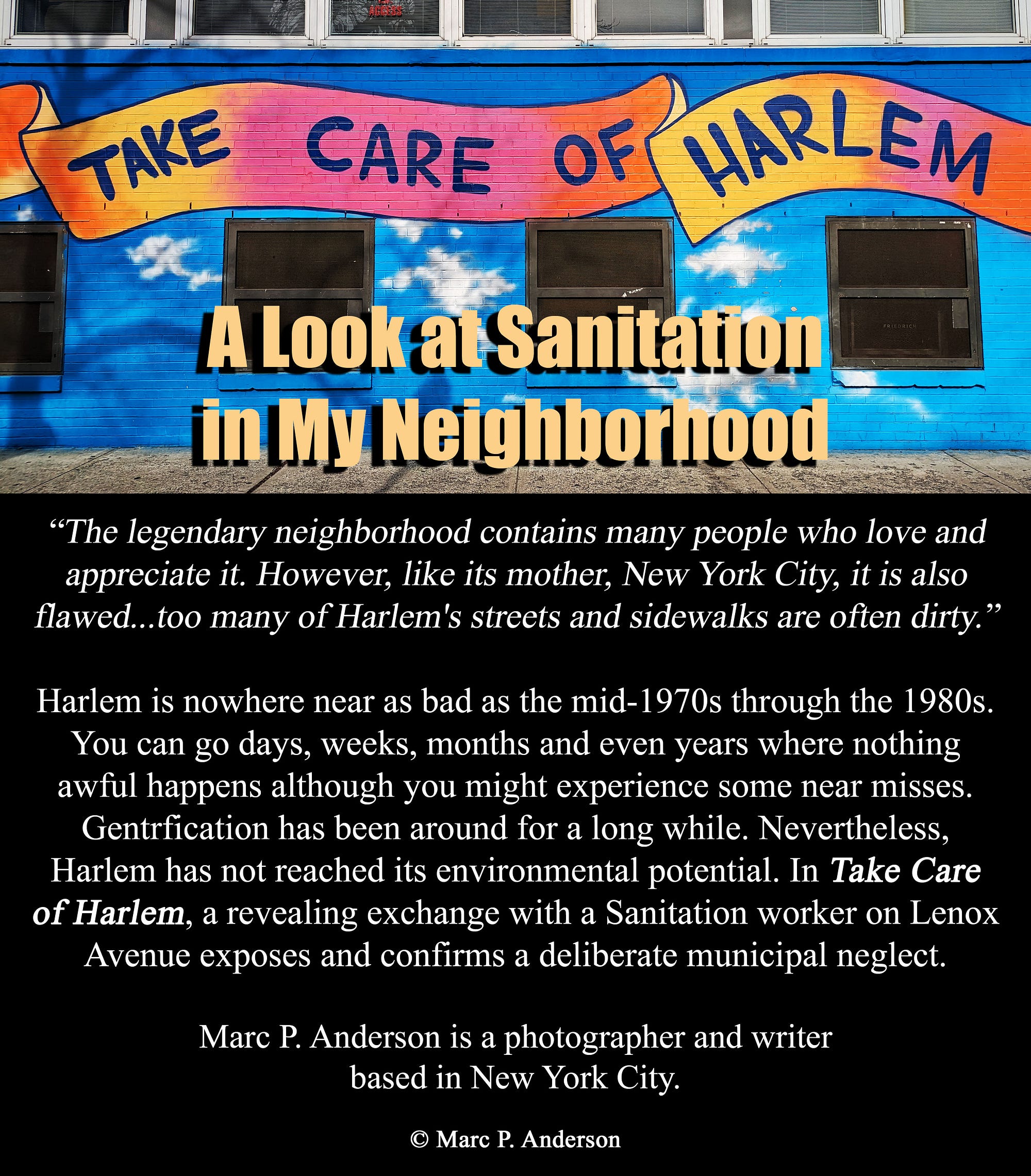
Although it is not the city of my birth, childhood and teenage years, as an adult I have been a New Yorker for 47 years, by far longer than anywhere else. I lived first in several neighborhoods in Brooklyn for 23 years. I moved to Harlem 24 years ago, when it became the single neighborhood in which I have now spent most of my life in New York.
How is Harlem, from my perspective? The legendary neighborhood contains many people who love and appreciate it. However, like its mother, New York City, it is also flawed and in one respect is rarely totally well.
Harlem suffers from what I would call multiple personality disorder. Parts of it are doing fine, gentrified and filling up with new (white) residents who tend to demand and receive better services or at least more attention. The architecture is beautiful and the history of Harlem is filled with landmarks that are incredible and events that are unforgettable.
Other parts, although not as widespread as in the past, are still very large in size but they have seen less progress. They sometimes relive aspects of the bad old days of drugs, crime and especially trash.
The various parts are often close together or blend quickly into each other. There are people who want Harlem to be its best and who try in various ways to help it reach its potential, most often through social services. But they are unable to fully correct its problems and they are up against the sheer amount that needs to be done beyond providing free food for those who are poverty stricken or without shelter.
Sanitation
One way you can immediately and always tell the difference is sanitation. The mother (city) who lets her children (neighborhoods like Harlem) wear soiled clothes and who never bathes them is guilty of neglect and preventing them from having a basic uplift known as cleanliness.
Too many of Central Harlem’s streets and sidewalks are often dirty, which creates an environment that supports poverty and destructive behaviors. If no one else cares about where you live and how it looks, why should you? People take it for granted that this is just the way it is, and they don’t bother to complain as often as they could. Sometimes youth and those who are simply careless add to whatever trash and chaos have been dumped on the streets by the mentally ill and their drug addict street neighbors. Somebody else will clean it up. Except there is no somebody.
Too many residents and property owners mostly ignore the effect that weak to nonexistent cleanliness has, in favor of focusing only on safety, when both are essential to Harlem’s success. They won’t sweep in front of their own property, a New York thing, where somebody else is always going to do it. They walk by overflowing garbage cans, believe trash on the sidewalk and in the street will be picked up by a Sanitation Department that couldn’t care less and simply won’t do it, and they accept the rats in certain areas that feast at night. There are owners of buildings who will not invest in reasonable upgrades such as painting their stoop or planting tree guards to protect trees that provide shade and promote the health of everyone. Housing costs remain defiantly high anyway and property values don’t ever fall because of overwhelming demand, so they get away with their own contributions to what holds Harlem back.
The Sanitation Department seems to choose which areas will receive attention and which will not. Street sweepers seem almost nonexistent for long periods of time in Harlem and I have only seen a few this year. The emptying of public garbage cans and cleaning the curbs is in my experience very infrequent. The Sanitation Department apparently considers it their least important responsibility, as the following astonishing but true interaction confirms.
“Pick It Up”
It was close to noon on May 14, 2024. I walked on Lenox Avenue/Malcom X Blvd. When I reached the southeast corner of 132nd Street and Lenox, I saw a pile of trash, plentiful and unavoidable, next to an overflowing garbage can. It was an example of a problem that appears randomly all over the city and it is often nearly out of control because everyone just looks past the random heaps of refuse. Still, Harlem has more than its fair share.
But there was an unexpected twist. Parked right next to the blunt trash pile, which spread out on the sidewalk and spilled past the curb into the street, was large Sanitation Dept. truck. One worker, possibly the driver, was inside the truck. Another worker was standing between the truck and the trash. The workers had been talking intermittently to each other. The one outside the truck may have bought something from a nearby store. They might have been taking a break. Regardless, they were not doing anything whatsoever about the trash that was directly next to their truck. They acted as if it wasn’t even there.
I walked over to one of the workers, a black male (like I am) and asked a question. “How would a citizen be able to bring attention this,” I said as I pointed to the trash. It was my way of trying to bring awareness to the sanitation worker who was standing right in front of it but doing nothing about it.
He looked at me and, with the very definition of a smirk, said that I should “pick it up”.
I was appalled. The sanitation worker, whose very job, paid for by my tax dollars, was telling me to pick up a huge pile of trash on the street, that is, I should do his job. Never mind that I would not have had a place to put it. His remark was the most smug, insulting statement imaginable from a sanitation worker. He was telling me to clean the street myself. His face said that he thought his remark contained some sort of humor but he knew that he was being extremely offensive.
I calmly replied. “I’m (I stated my age) years old. I have a bad knee. You’re saying I should pick it up?” I didn’t state the obvious, that I didn’t put it there, and that it wasn’t my job. Left unsaid was that I didn’t live on the block. But I still had to walk by it. I was still a Harlem resident who was subjected to what could only be described as a filthy accumulation of garbage.
He looked back at me and realized that it was the wrong thing to say, but he wasn’t apologetic. Instead, he responded “Call 311.” In other words, he intended to deflect what my query was about, by telling me to call to the city’s non-emergency line for citizen complaints. He knew this was also a non-answer and still extraordinarily dismissive. But comparatively, it was less offensive than what he had said a moment earlier. It was a new non-reply that he thought he could get away with.
I repeated his words as I looked back and forth at him and at the trash. “Call 311,” I said, with an expression that let him know that I was aware that he had been deliberately disrespectful to me. He thought I was ultimately a nobody and no one would ever know. Moreover, he was not going to do anything about the trash, despite the truck being right there, and he was letting me know it.
I walked away in disgust, thinking about how an older white person in a wealthier part of town would never have been told by him to pick up a huge pile of trash on a public street that was not of one’s own making. We were both men of color but he had been conditioned by society to participate in the view that I, a black Harlem resident, was not worthy of a serious response nor any action at all to the problem I reported. Both I and my alerting him to the trash had no value and if anything, it was all an annoyance to him.
I turned and proceeded on to 125th Street where I bought some groceries. Then I began my walk back but with a new purpose. I decided that once I reached the same corner where the sanitation worker had mocked my question, I would take my cell phone out and photograph the trash. I would note the time and the position of the truck. I would report the encounter to the city and consider filing a complaint. I would contact the city council person for my district as well as the city council president, my local congressperson and perhaps even local news media, to tell them about the response from the sanitation worker. They would be able to identify him based on the details I would provide.
Another path would be to tell the story on the Internet or on social media platforms where I had accounts. I wouldn’t normally do any of those things and I didn’t want to necessarily get him in trouble. But he deserved whatever reprimand from his embarrassed superiors that would hopefully result from being exposed.
When I got back to the corner, about twenty minutes later, there was a surprise. The trash had been partly, although noticeably not entirely, cleaned up. The worker had apparently reconsidered. He might have thought about the consequences of his words to a citizen and his lack of action. He might have realized that I could have complained to my representatives, contacted the city and revealed his words in multiple ways. He apparently thought about it and decided to mitigate his mistake since he didn’t know me or know what I might do about it.
Yet he didn’t entirely clean the trash from the street. About 20% of it remained. I thought that his leaving some trash on the street was deliberate. It was his way of sending a message, to say that he didn’t have to totally do the right thing. He could still display an attitude of defiance, even if it was less than before. He just wasn’t going to fully do his job.
An Apathetic Mother
Within this frustrating background that reinforces apathy toward Harlem, beyond its dedicated residents there are still homeless people, hopeless/rebellious youth and people of all ages who are lacking in and not pursuing education or employment. The result for far too many is personal economic and financial inability to take care of themselves. All the riches of the rest of Manhattan, tantalizingly near and visible from anywhere on Harlem’s avenues, are an advantage that for too many are meaningless.
Harlem’s lost or willfully non-aspirational people distract themselves and each other with substance abuse, petty disagreements or the intimidation of those they perceive as vulnerable. Add in mental illness that arises from all these various roots and the effects spill over to everyone else at some point.
But environment matters, especially so in Harlem. When a street looks rundown, when one is expected to visit restaurants that put tables and chairs on sidewalks next to trash in the assumption that people don’t mind and will eat there anyway, then it means that they have all given up on the negative physical condition of the street. They have accepted it as normal and look the other way. But the apathy that permeates about the trash intensifies the reality that the city doesn’t care.
No, Harlem is nowhere near as bad as the mid-1970s through the 1980s. You can go days, weeks, months and even years living in Harlem where nothing truly awful happens although you might experience several near misses. Gentrification has been around for a long while.
Nevertheless, too much of Harlem is not reaching its potential and it is still a place that, for black people, isn’t the strongest foundation for a positive future that it should be. They still think about leaving and going where it is cleaner and greener.
Harlem’s mother, New York City, has many similar children whose names are the South Bronx, Bedford-Stuyvesant, Brownsville, East New York and others. She can be apathetic about their cleanliness, too. She will give lip service and pretend to care, sometimes throwing money at their problems so that she can say that she has done something, but they don’t always get the targeted resources needed to specifically improve cleanliness. The city will rate streets as clean when they are not or are clean only in some areas.
As the parent, New York focuses on her rich kids: Midtown, Upper East Side, SoHo, TriBeCa, Hudson Yards, Upper West Side, etc., often the most popular tourist areas. Harlem has plenty of tourists but I have watched them, too, walk by trash and ignore it as part of Harlem’s “gritty, urban” look.
Harlem would be far better if the first thing cut in the city’s budget was not sanitation. The city must acknowledged that from severely compromised streets grows the rest of the negatives that Harlem doesn’t deserve. It must clean the streets and the parks, plant and maintain trees that purify the air, and work relentlessly to improve the streets themselves. This will raise community pride and expectations that will be the stronger foundation for solving the rest of Harlem’s problems.
If the city and its residents take care of Harlem, it might surprise everyone with its ability to finally take care of itself.